

After oddsmakers release their lines, sports bettors expect odds movement right up until the start of the event. These line movements or "line moves" are common, and if you placed a wager before the odds moved, the price you locked in is what sportsbooks will pay if the bet wins.
This article explains why lines move and what line moves can tell interested bettors. Whether you're preparing for a trip to Sin City and are curious about Vegas line moves or you're placing wagers from home on one of the best sportsbook apps, the content below will be useful.

Terms and Conditions
GAMBLING PROBLEM? CALL 1-800-GAMBLER, (800) 327-5050 or visit gamblinghelplinema.org (MA). Call 877-8-HOPENY/text HOPENY (467369) (NY).
Please Gamble Responsibly. 888-789-7777/visit ccpg.org (CT), or visit www.mdgamblinghelp.org (MD).
21+ and present in most states. (18+ DC/KY/NH/WY). Void in ONT/OR/NH. Eligibility restrictions apply. On behalf of Boot Hill Casino & Resort (KS). Pass-thru of per wager tax may apply in IL. 1 per new customer. Must register new account to receive reward Token. Must select Token BEFORE placing min. $5 bet to receive $300 in Bonus Bets if your bet wins. Min. -500 odds req. Token and Bonus Bets are single-use and non-withdrawable. Bet must settle by and Token expires 2/22/26. Bonus Bets expire in 7 days (168 hours). Stake removed from payout. Terms: sportsbook.draftkings.com/
Why did a line move?
There are several reasons why sportsbooks update odds and change point spreads, over/unders, moneylines, and other bets. Part of your job is to understand why a line moved because betting line movement can be an important clue (more on that later).
Oddsmakers typically update lines due to:
- New information
- Sharp money
- Liability
- Copycat sportsbooks
New information
New information causing sports betting line movement could be anything from injury news, a trade, or a confirmed rumor that the flu is going around a locker room. New information could also be an unexpected inactive player 90 minutes before an NFL kickoff or a big bat missing from an MLB lineup card.
Sportsbooks want their lines to be accurate because inaccurate lines lead to lopsided betting and a losing outcome for the book. With this in mind, sportsbooks adjust lines to keep them accurate based on new information. As we explain in our sports betting strategy guide, you can sometimes get information before an oddsmaker and bet before a line moves.
Liability
Sportsbooks don't like liability and usually want to limit their exposure to a losing outcome.
Imagine a sportsbook with 95% of the money on the Yankees and 5% of the money on the Mets in a Subway Series. If the Yankees win, this sportsbook loses money even after its 10% vigorish on every bet. Sportsbooks would much rather have 50% of bets on the Yankees and 50% of bets on the Mets and then collect their 10% vigorish from all bettors because in that scenario, they can't lose. In an effort to avoid liability, like in the 90/10 example above, sportsbooks shift numbers when the money starts to become too lopsided.
Sharp Money
Sportsbooks develop profiles on customers and have a great idea of who is good at sports betting and who isn't. Professional bettors with a proven track record of winning are sometimes referred to as "sharps," "wise guys," or "respected money," and their bets can impact a line within minutes. In fact, sharp money can move lines even when it creates a liability issue for a book because sportsbooks value the opinions of certain professional bettors.
You can think of sharp money moves somewhat similarly to the "new information" example above. A sharp bettor's opinion is the new info this time.
Copycat sportsbooks
Sportsbooks that don't get a lot of action from sharp bettors will copy line moves from sportsbooks that do. For instance, Pinnacle Sportsbook in Canada may adjust a point spread from -3 to -3.5 because of sharp money, and bet365 might take notice and move to -3.5 even though it didn't directly receive any sharp money.
In the example above, bet365 is respecting Pinnacle's line move and trusting that it's based on sharp money. So in this bet365 / Pinnacle example, someone might say sharp money moved the line at bet365, which is indirectly true because the sharp money came in at another sportsbook. This type of copycat line movement is common today. That wasn't necessarily the case decades ago when Las Vegas had a monopoly on U.S. sportsbooks.

Terms and Conditions
New customers only. Deposit min. $10. Place first bet of min $5 and get $200 in bonus bets if your bet wins.
Gambling Problem? Call 1-800-GAMBLER.
21+ and present in OH.
Which Scenario caused A Line move?
Seasoned sports bettors who understand sports betting markets can diagnose a strong assumption about which scenario above caused a line move.
When new information causes a line to move, that's the easiest to diagnose because you can simply go to X or another sports news website and verify what happened. For example, if the Chiefs move from 6-point favorites to 3-point favorites and news broke that Patrick Mahomes was injured around that time, we can safely assume that the Mahomes injury is the exact reason the point spread moved.
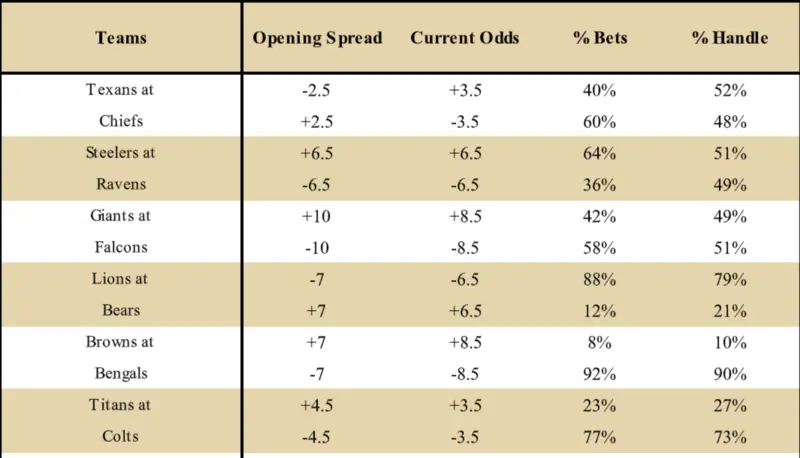
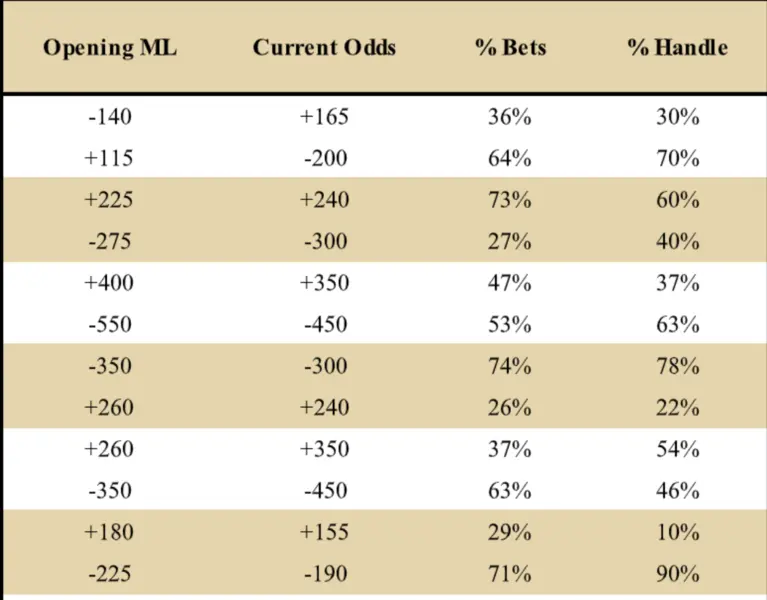
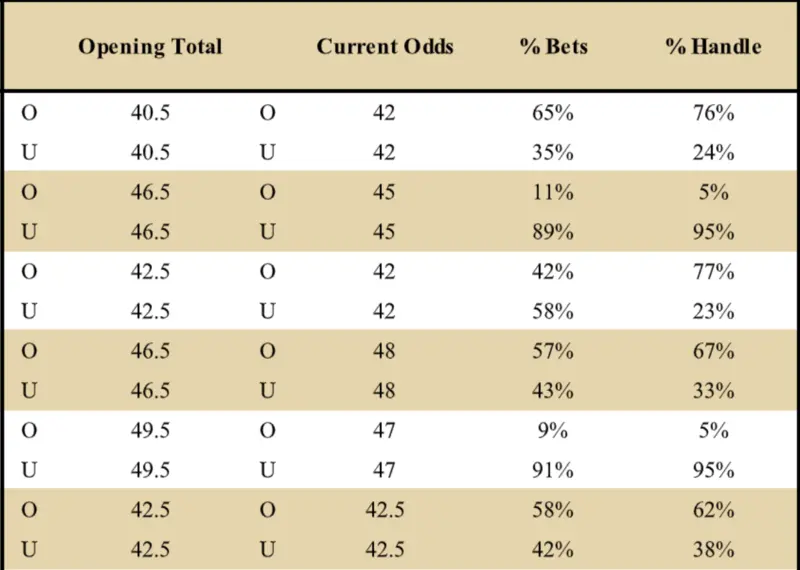
To determine if a line moved because of sharp money, you can use public betting percentages, AKA "betting splits," to compare the money wagered on each side with the number of bets on each side. If a team has a low percentage of bets, but a high percentage of dollars at a respected sportsbook, this is a possible indication of sharp money. Understanding this concept can help bettors "follow the smart money" or "fade the public."
Below is an example of betting percentage published by BetMGM during the last NFL season.
Reverse Line Movement
Combining betting percentage with sports betting line movement can paint a vivid picture for curious sports bettors.
If the betting percentages reveal a lot of bets are on one team and the sportsbooks move the line in a manner that encourages more action on that team, this is called reverse line movement. It's a red flag that sharp money is on the side with less money bet.
For example, if the Eagles are -6 favorites vs. the Cowboys and the overwhelming majority of bets and money come in on Philadelphia, because of liability reasons outlined above, you should expect the next line move to go up to -6.5. However, in a reverse line move scenario, the sportsbook moves the line down to -5.5, which entices more Philadelphia wagers. When this happens, you should ask yourself, "Why would the sportsbook entice more betting on Philadelphia and encourage me to make the betting even more lopsided?" The answer is usually that a sharp bettor's action (or sharp action at another sportsbook) has been compelling enough for the book to take the risk.
Identifying reverse line movement takes some practice, but it's a great data point to be aware of. There are "contrarian" professional bettors who consider reverse line movement their bread and butter. Author and pro bettor Josh Appelbaum is a great follow on X for anyone curious about these concepts.
I always encourage other bettors to use multiple data points, and reverse line movement is a great one. It's not the only box to check when deciding to make a wager; take other factors into consideration, too. Trusted pick service providers can help you make decisions, too.
The Timing of Line Movement
The timing of line movement can tell us a lot.
On Sunday nights when the NFL's lines for the following weeks are being released, there's a lot of volatility because professional bettors are putting their wagers in early. Recreational bettors typically aren't betting that early in the week. They're usually out celebrating or licking their wounds, depending on how the prior week went.
Knowing that it's mostly pro bettors who are betting the week before an NFL game, we often assume that line movement super early in the week is a reaction to sharp money. Note: Sometimes "head fakes" occur which is when professional bettors intentionally put in smaller wagers early in the week to manipulate a line so they can bet it in the opposite direction later in the week when there are higher limits. There's no way to know for sure if a move is a head fake or not.
Who Sets the Lines?
Sportsbooks set their lines using a combination of internal experts, formulas, and other factors. These can include internal power rankings as a base. For example, these internal rankings could indicate that one team is 3.5 points better than its opponent. This is then adjusted based on factors like which team is playing at home, if there are any injuries that need to be accounted for, and more. This could lead to the example 3.5-point favorite being posted as a 4.5-point favorite if there are factors in their favor, or being dropped down to a 2-point favorite if oddsmakers believe elements are working against them.
Some sportsbooks will choose to copy the opening line of a different prominent sportsbook and then adjust things based on their bettors. A sportsbook based in the same city as a professional team may adjust things to account for home fans heavily betting on that team, for example.
Line Movement at Different Sportsbooks
It's helpful to monitor line movement at all the best sportsbooks, even those you're not allowed to use in your state. For instance, if FanDuel, DraftKings, BetMGM, and Caesars all have the Eagles at -7 and your bet365 app is showing -6.5, then perhaps bet365 is late to the party and will be moving up to -7 soon. If that's true, then you'd be wise to take advantage of the bet365 number if you like the Eagles.
But what if bet365 wasn't late to the party in the Eagles example above? Perhaps they were first to the party, and everyone else has been at -7 for days. You'd quickly be able to tell the difference in these two scenarios if you've been monitoring line movement at various sportsbooks throughout the week. When you're watching closely, anomalies stick out like sore thumbs.
If you currently only have one sportsbook and are considering downloading more apps so you can monitor line movement, make sure you take advantage of the best sportsbook welcome bonuses and promotions.
Line Shopping At Different Sportsbooks
It's always a good idea to shop around at different sportsbooks so that you can find the best value for the bet you want to place. You'll find different spreads, totals, moneyline odds, and more at different books, so don't miss out on the value that having multiple sportsbooks can provide. You want your bankroll dollars to be maximized as much as you can. You can even use sports betting tools like Prop Professor and Outlier to help you compare lines across a wide variety of oddsmakers.
Looking at an example can show just how valuable this is. Let's say you like an underdog team to outright upset a favorite. One sportsbook has the odds at +145, another at +150, and a third at +155. A winning $100 bet at these three sportsbooks would net you profits of $145, $150, and $155, respectively. Those gaps may not feel very large on their own, but an extra $5-$10 on every winning wager you make can quickly add up over time!
While the above example looked at a moneyline bet, the premise holds true for most markets, ranging from next touchdown scorer props to NBA Finals futures bets.
Watch The Vig Closely
Just like smoke is a precursor to a large fire, vigorish movement is a precursor to point spreads or totals being adjusted.
For instance, if we see -120 vigorish on an over of 47.5 points and +100 on the under, that is an indicator that the sportsbook Note: Assuming a standard sportsbook that typically offers -110 juice on both sides. might be moving to 48 points soon. It's also a strong sign that the sportsbook is far more likely to move up to 48 than it is down to 47.
If you're still struggling to understand this concept, try using logic. What is a sportsbook doing when it moves the juice from -110 to -120? Answer: It's slightly discouraging you to make that bet. Now, why would it discourage betting on the over? Answer: Because it's taken a lot of money on the over and it's trying to decrease its liability and balance its books. If that's true and the money continues to come in, the sportsbook's next move will often be to adjust the line.
